










More than a tenth of the North Sea could be covered by wind farms by 2050, a study suggests.
Researchers said that offshore wind projects could cover eleven per cent of the sea if all proposed energy projects by North Sea nations went ahead.
Currently, they occupy one per cent. A team from Heriot-Watt University mapped a scenario for how offshore wind could reshape the North Sea by 2050, the year the UK has committed to hitting Net Zero.
They stressed that their findings were a projection, rather than a prediction, of where the wind farms might be located.
Dr Simon Waldman, assistant professor of energy technologies at Heriot-Watt University’s school of energy, geoscience, infrastructure and society, said: “Our scenario shows the scale that we would be looking at if every country were to build the amount of offshore wind capacity that they have promised.
“It’s important to be clear that this isn’t a prediction of what the North Sea will look like in 2050, it’s simply a projection based on the data and national ambitions we have today.”
Analysis shows that current political commitments imply a total of around 19,400 offshore wind turbines across the North Sea by 2050, including those already built.
The study examined both operational offshore wind farms and projects already in national development pipelines across all seven countries with North Sea waters: the Netherlands, Belgium, Denmark, Germany, the UK, Norway and France. Where necessary, hypothetical wind farms were added to bring each country’s total capacity in line with its stated commitments.
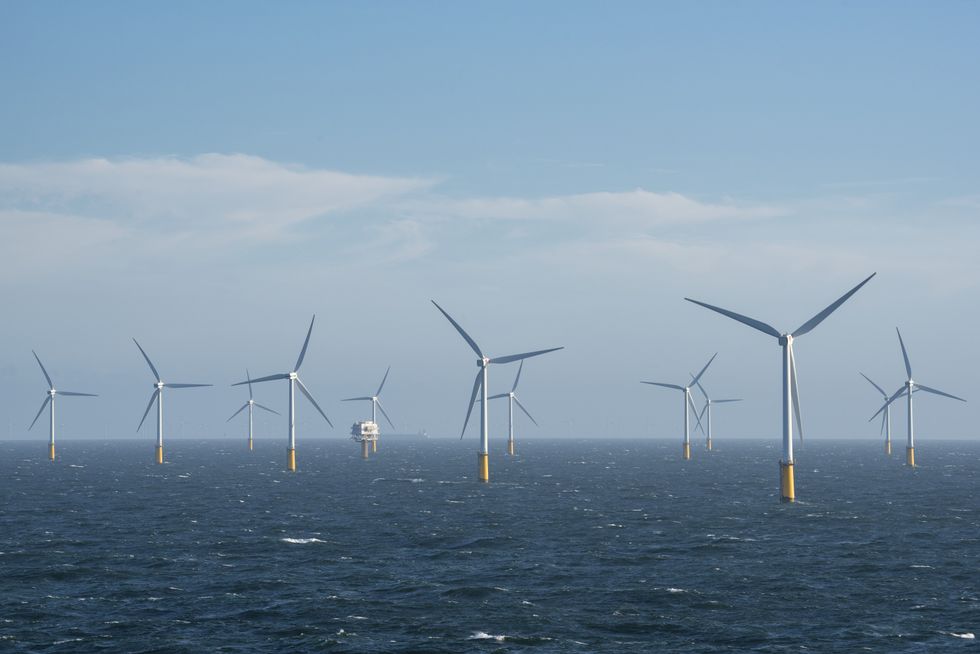
Offshore wind farms could make up a significant portion of the North Sea
| GettyDr Waldman said: “We originally began this work because we wanted to understand the environmental effects of a very large rollout of offshore wind.
“To do that properly, we needed a plausible set of turbine locations and that simply didn’t exist at the time.
“Since the project began, national ambitions have grown in response to global events, so we updated the dataset to reflect the higher targets governments now have.”
By 2030 the UK is projected to remain the largest offshore wind nation in the North Sea, with roughly 4,200 turbines in operation.
LATEST DEVELOPMENTS
 Ed Miliband has made renewable energy rollout a primary target | PA
Germany follows with around 2,700 turbines and the Netherlands with approximately 1,700.
By 2050, these three countries are expected to increase in scale, with the UK estimated to host around 6,300 turbines, Germany in the region of 4,300 and the Netherlands just over 4,200.
The Netherlands is projected to be the most intensively used national zone, with offshore wind farms occupying almost a fifth of its North Sea waters (19 per cent) by 2050.
Belgium follows with projections of around 18 per cent, ahead of Denmark at about 15 per cent and Germany at around 14 per cent.
The UK follows at around nine per cent, Norway at around eight per cent and France at around seven per cent.
Taken together, projected and operational offshore wind developments would cover approximately 23,000 square miles of the North Sea, or about eleven per cent of its surface.
Dr Waldman added: “To build this scenario, we brought together a wide range of international marine and energy datasets, from national targets and spatial plans to seabed depths, wind and wave records, existing infrastructure and projected turbine technologies, to create a realistic picture of what current ambitions might mean in practice.
“When placing our projected future wind farms, we tried to avoid shipping lanes, environmentally-protected areas, existing seabed cables and pipelines, and more.
“What this shows is the scale of activity we will be dealing with if offshore wind grows as promised, and the practical considerations that come with that.”
Experts warned that the effect on wildlife and maritime industry would need to be monitored. Professor Rodney Forster, from the Hull Marine Laboratory at Hull university, told industry publication The Fishing Daily: “The North Sea supports fragile marine ecosystems and coastal communities dependent on logistics, fishing and energy industries.
“It’s clear that coming decades will see a significant increase in offshore wind developments. As these expand, we need to understand possible impacts on those diverse ecosystems and the implications for wider marine industries.”
Last year, a report found that metals used to protect offshore wind turbines could leach into the surrounding waters, potentially posing risks to ecosystems.
Professor Gordon Watson, of the University of Portsmouth, said at the time: “Offshore wind farms are a vital part of our clean energy future, but at the moment there is limited data on how these metals affect the environment near operational offshore wind farms, so it’s hard to assess the full risks.
“We are definitely not saying stop building offshore wind farms, we just need to monitor them appropriately - especially as they continue to expand. “The plans to scale up are ambitious and come with challenges that must be addressed.”