











The NHS has vowed to “stamp out” corridor care with specialist “hit squads” sent into the worst-hit trusts.
In a bid to restore safety and dignity to frontline care, ministers say they will end the practice by the end of this Parliament - backed by new urgent care centres, new funding and hard data tracking every case.
The move comes after years of mounting outrage over vulnerable patients left waiting on trolleys in packed corridors - a crisis described as a ‘national emergency’ by the Royal College of Nursing and one which critics say has become "normalised" across parts of the health service.
Frontline staff have warned some NHS hospitals resemble a "war zone" with examples of elderly patients being left on trolleys in corridors for days, while staff carried out procedures in toilets due to lack of space.
TRENDING
Stories
Videos
Your Say
Whistleblowers have described "chaotic" and "depressing" conditions, with reports of patients dying in corridors and nurses using sheets to preserve dignity during intimate procedures carried out in public.
Health Secretary Wes Streeting said: "For too long, the normalisation of corridor care has been baked into our NHS - it’s unacceptable, undignified and exactly why this government is shifting the dial for patients and staff.
"We're sending in specialist teams of experts to identify the causes in some of the worst offending trusts and swiftly rectify the problems they find.
"That, plus new and expanded urgent care centres will mean patients are treated more quickly and in the right place, while easing pressure on busy A&Es to care for the most serious cases.
"We are cutting waiting times and moving away from unacceptable corridor care, building an NHS that treats patients with dignity.
"After the NHS performed significantly better this winter, we are going further to strengthen services and build a system fit for the future, backed by record investment."
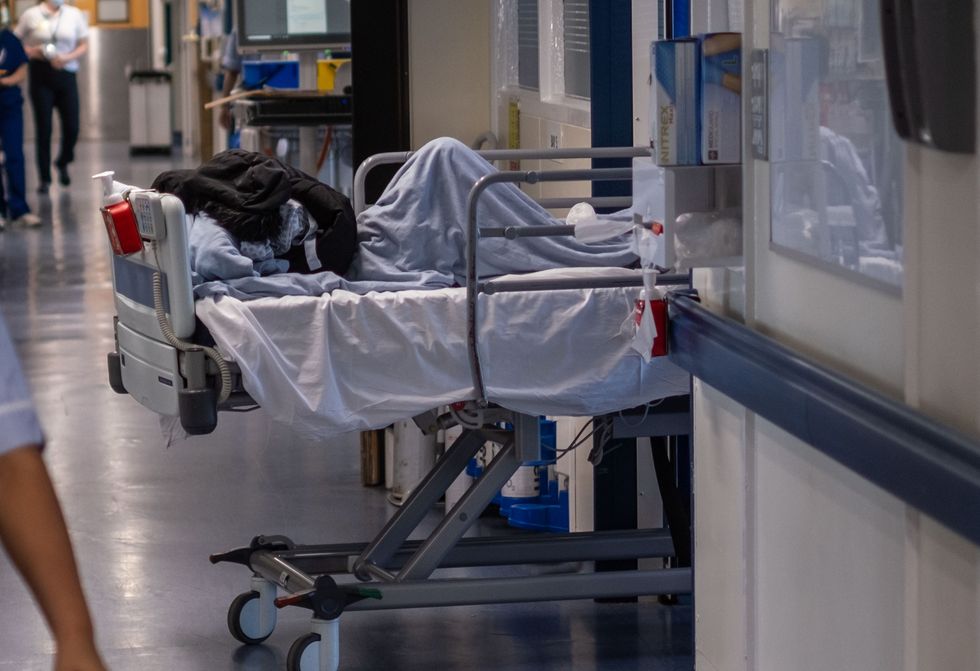
NHS to send in specialist 'hit squads' to clean up corridor care crisis
| PAEvidence suggests the worst corridor care is concentrated in a small number of NHS trusts - prompting a targeted crackdown.
Elite clinical teams are now being deployed directly into struggling hospitals, working side-by-side with senior staff.
Their mission is to fix patient flow, speed up discharges and stop dangerous bottlenecks that leave patients stranded in corridors.
The teams are also helping hospitals use their own data better - predicting demand surges before they hit and improving decision-making at the top.
And for the first time, NHS England says it is introducing an official definition of "corridor care", with hospitals set to publish regular data from next month - exposing where the problem persists.
The crackdown comes alongside a major expansion of urgent care services designed to take pressure off overwhelmed A&Es.
LATEST DEVELOPMENTS:
A total of 40 new or expanded centres are being rolled out across England, backed by a £215.5million investment.
This includes:
- 10 new urgent treatment centres
- 4 expanded urgent treatment centres
- 5 new same-day emergency care services
- 21 expanded same-day emergency care units
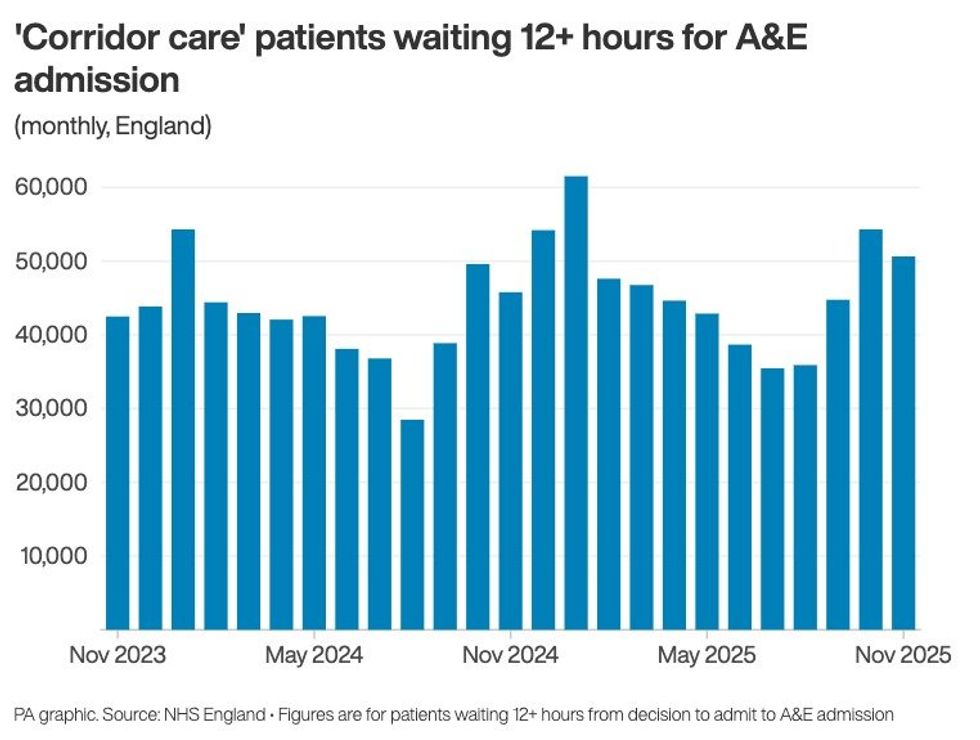
Data from December 2025 shows how many patients waited 12+ hours in A&E
|PA
These services treat patients with less serious conditions - from cuts and sprains to infections - or provide rapid diagnosis for urgent but stable cases, helping avoid unnecessary hospital admissions.
Despite the scale of the crisis, NHS England says pilot studies suggest the strategy is successful.
At Queen’s Hospital in Romford, corridors that were previously packed with patients are now clear.
The NHS say a new assessment system there has slashed waiting times by 37 minutes, while greater access to senior clinicians means patients are being directed to the right care more quickly.
Specialist frailty units are also helping elderly patients avoid long waits - offering rapid assessment and support to get them safely home sooner.
Other hospitals are already seeing striking improvements after targeted intervention:
- The NHS says Hull has cut ambulance handover delays by 27 per cent and reduced 12-hour waits by 47 per cent
- Royal Blackburn has cleared its main corridor and reduced long waits by 18 per cent
- Blackpool has slashed 12-hour waits by 43 per cent, thanks to better data use and a new 24-hour assessment unit

Evidence suggests the worst corridor care is concentrated in a small number of NHS trusts
|PA
The NHS hope these changes will lead to fewer patients stuck waiting in corridors - and faster treatment for those who need it.
Professor Mumtaz Patel, president of the Royal College of Physicians (RCP) said: "Corridor care puts patients at risk and forces NHS staff to deliver care in unacceptable conditions.
"The RCP welcomes this targeted support and investment for trusts, alongside new urgent care capacity to reduce demand at the hospital front door.
"However, corridor care is a complex issue. It’s not just about hospital capacity - it’s the predictable result of long‑standing workforce shortages and an underfunded social care system.
"Without investment in staff, facilities and infrastructure, and a renewed focus on social care reform, this is just fixing the symptoms, not the causes, of corridor care."
Professor Tim Briggs, who leads the GIRFT programme, said: "We’re working hard to support the trusts facing the biggest challenges with patient flow and we’re seeing some good early evidence of reductions in corridor care for patients.
"Our focus over the next six months is to take what we’ve learned and cascade it across the whole NHS, so we can improve care for patients and eliminate this issue once and for all."
Dr Ragit Varia, president of the Society of Acute Medicine (SAM) said: "Corridor care has unfortunately become commonplace and is unacceptable for both patients and staff, so we are pleased to see further action being taken as opposed to simply redefining the corridor.
"SAM has been increasingly concerned that a definition which is open to interpretation risks encouraging ‘gamification’ rather than genuine improvement, which is why more active intervention is necessary."
Watchdog groups say the human cost of corridor care has been devastating.
Healthwatch England acting chief executive Chris McCann said: "We welcome the support that's being given by specialist teams to trusts facing acute corridor care pressures.
"We hope this will address the evidence we shared, along with nursing leaders, of distressing patient and staff experiences earlier this year.
"Even one case of corridor care is one too many. It is vital that every NHS trust in England commits to preventing or ending corridor care, and that the public can see where progress is being made. The new, regular data due to be published from next month about the number of corridor care cases in every hospital is therefore welcome.
"As new urgent care sites are rolled out, it will also be important for the NHS to make local communities aware of the most appropriate place to visit when they have an urgent care need".