









Sex crimes have soared across the European Union over the last decade, with Spain home to the sharpest rise in the number of rapes in a given year, a new report has found.
The findings, from The Campaign for an Independent Britain, Stand for Our Sovereignty, and think tank Facts4EU, will heap further pressure on Keir Starmer to stick to his Brexit red lines and not open Britain's doors to an influence of violent criminals from the continent.
In the wake of last week's rout, which saw Labour lose control of more than 30 councils across England and around 1,500 councillors, Starmer has promised sweeping changes to get his premiership back on track.
This included “a new direction for Britain” at an upcoming EU summit in Brussels.
Opponents fear that restoring freedom of movement will be the price of entry to the EU's single market and customs union.
And an active scheme allowing 18-30-year-olds from Britain and EU states to live and work in each other’s countries has been branded the first step towards freedom of movement (the government strenuously denies this).
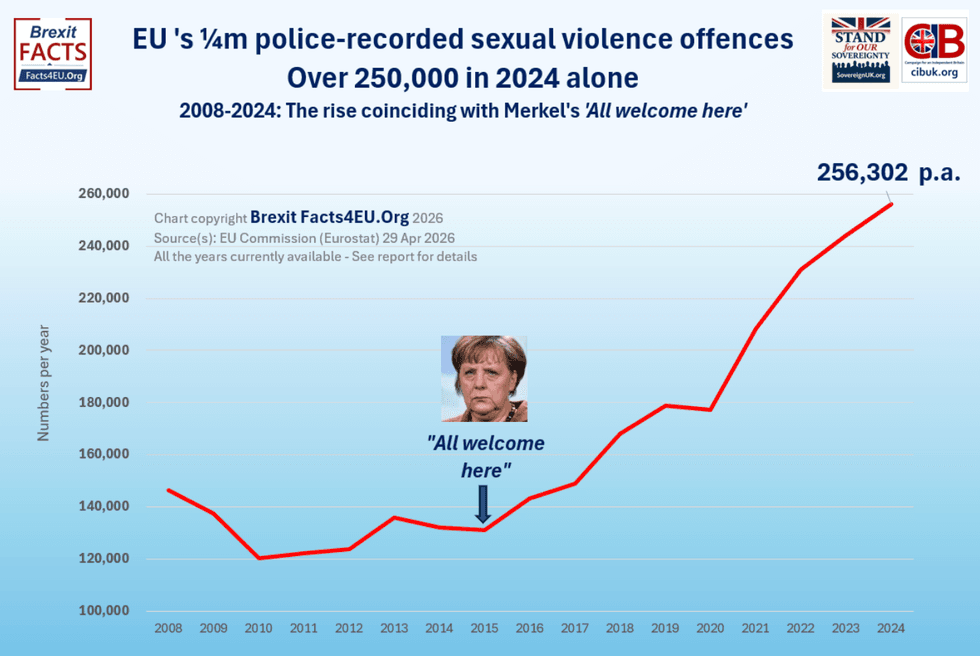
Rates of sexual crime have rocketed across Europe since 2015
|Facts4EU
A new report spells out the potential cost of this compromise.
As the graph above shows, rates of police-recorded sexual crime offences have rocketed across Europe since 2015, with around 1.9 million offences recorded over this period.
Over a quarter of a million (256,302) sexual offences occurred in 2024 alone.
As the authors point out, the jump in 2015 coincides with then-Chancellor Angela Merkel's decision to open Germany's borders at the height of the migration crisis (though correlation does not imply causation).
Rates of police-recorded rapes have also risen sharply since that year (see graph below).
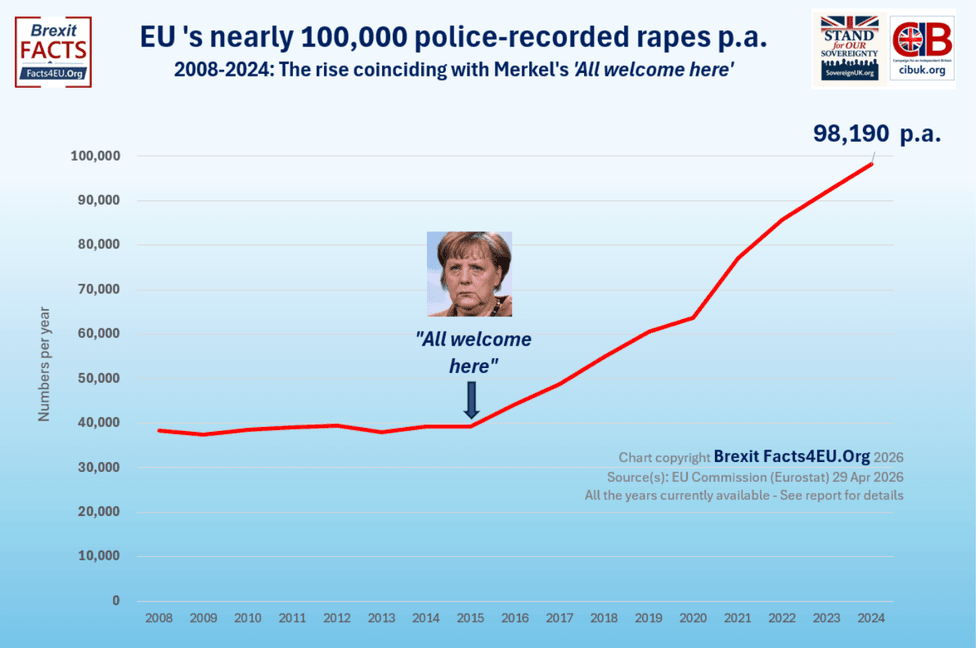
Between 2015 and 2024, 664,293 rapes were recorded
|Facts4EU
Between 2015 and 2024, 664,293 rapes were recorded.
Almost 100,000 (98,190) were recorded in 2024 alone, the last year for which we have data.
The vast majority were women, excluding minors.
By far the largest increase in rapes took place in Spain in the last couple of years. Spain’s increase is 4.2 times in 10 years. In 2020, it stood at under 1,600, and now the figures show over 5,200 rapes for 2024.
All told, rates of sexual violence have nearly doubled in the EU since 2014, and rates of recorded rape are up 150 per cent since that year (see graphs below).
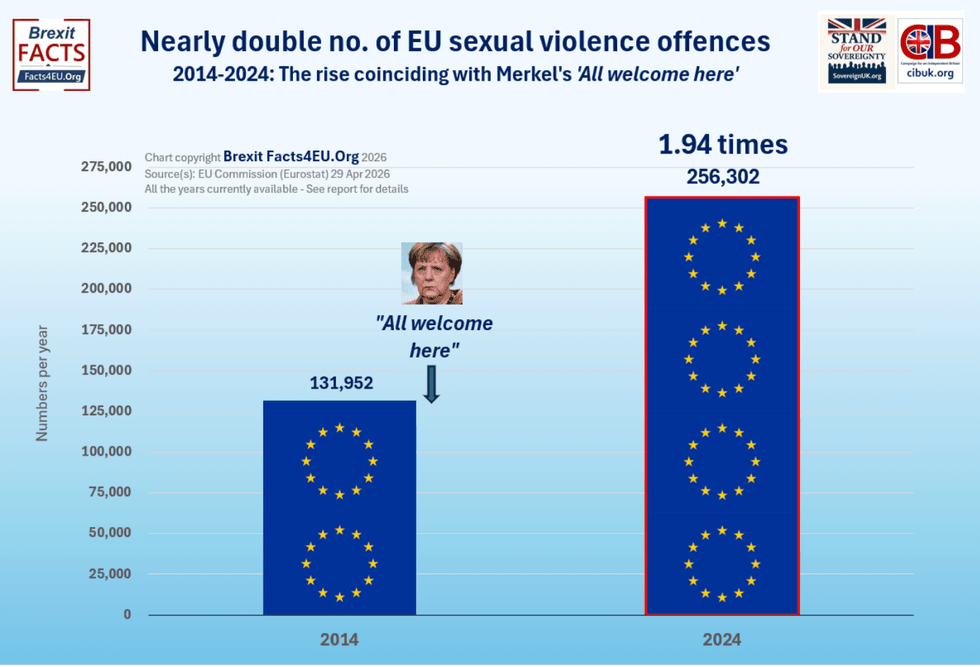
Rates of sexual violence have nearly doubled in the EU since 2014
|FACTS4EU
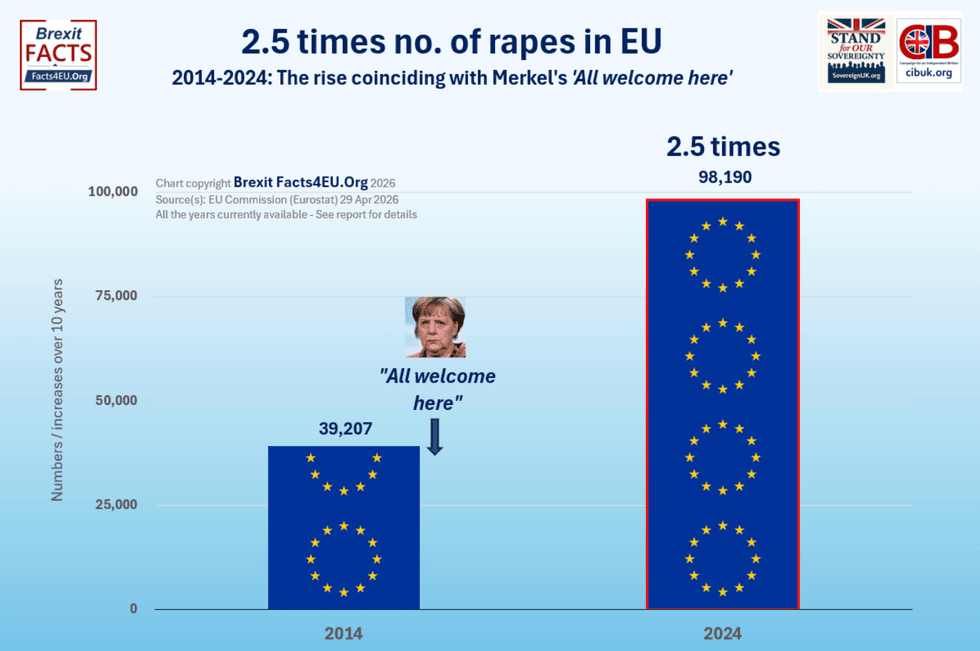
Rates of recorded rape are up 150 per cent since that year since 2014
|FACTS4EU
A critical factor the authors point out is that definitions matter a lot when analysing data.
When it comes to sex and, in particular, the crimes related to it, this is especially true. Not only do definitions change, but so does awareness and – importantly - the likelihood of certain crimes being reported.
There are also countries (e.g., in Scandinavia) where ‘serious sex crimes’ would not be recognised as such by most people in the UK.
The researchers, therefore, caution the above data and would say that it’s the trends that matter, and overall numbers.
How does Britain compare?
After much research, the researchers couldn't find a way to bring a true comparison of the data in the UK into line with that of the EU.
There are a great many reasons for this, including changes in the law, the way data on minors is included (it is not included in the EU), the fact that the nations that comprise the United Kingdom report separately, the periods for which data is available, and other factors.
What the report's authors can say is that there is clearly a large increase in sexual offences reported to police in Britain.
There can be no doubt that offences committed by illegal migrants are now starting to impact the figures, as well as those by elements of the community who are British nationals or who have residency but self-describe as categories other than ‘white British’.