








HMS Dragon has finally arrived in the eastern Mediterranean to defend Cyprus three weeks after it was subject to an Iranian drone strike.
Speaking to the Commons, Defence Secretary John Healey confirmed that the Type 45 air defence destroyer had arrived at the Cypriot coast.
He said: "I can confirm that HMS Dragon has arrived in the eastern Mediterranean and tonight, begins operational integration into Cyprus's defence, alongside allies.”
This comes three weeks after the vessel’s deployment
TRENDING
Stories
Videos
Your Say
Sir Keir Starmer announced HMS Dragon would be sent to Cyprus earlier this month, after RAF Akrotiri was subject to Iranian drone strikes.
On March 1, the British base in Cyprus was hit by an Iranian drone, with no casualties and little damage.
The next day, two further drones which were heading towards the base were intercepted.
Mr Healey continued in his address to the Commons, saying that the UK is continuing to track the threats to the UK, as well as its military bases.
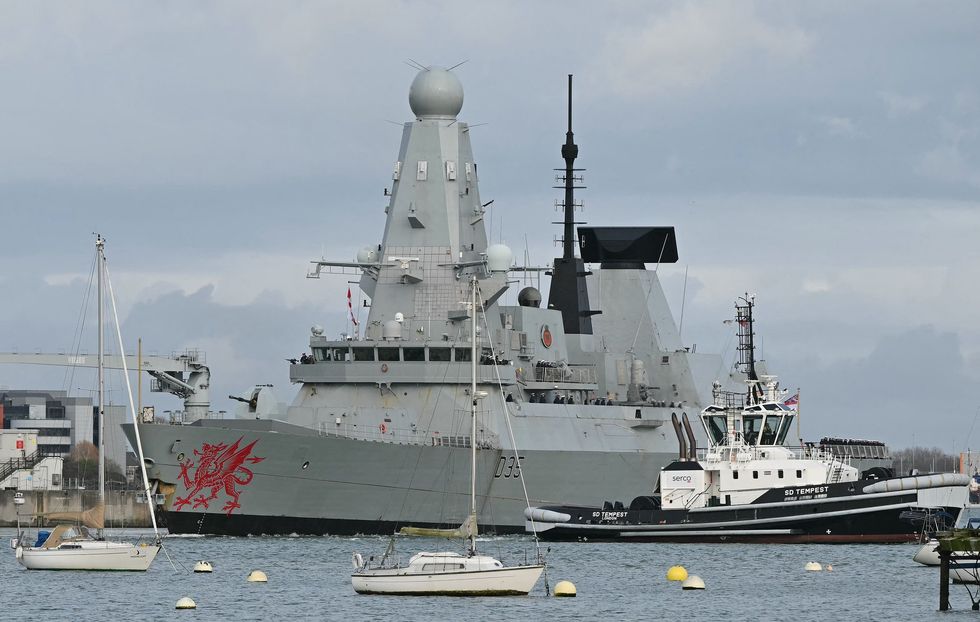
HMS Dragon moved at a glacial place since leaving Portsmouth harbour on March 10
|GETTY
He said: “RAF and Navy pilots have now racked up nearly 900 flying hours in defence of Cyprus, Jordan, Bahrain, Qatar and the United Arab Emirates.
“We have more jets in the region than at any time in the last 15 years.
“There are an extra 500 air defence personnel in Cyprus, and as more military capabilities are committed to the eastern Mediterranean, we’re working closely with the Republic of Cyprus to coordinate the contribution of allies, including the US, France and Greece, to reinforce the security of Cyprus."
However, HMS Dragon has lagged behind European allies, with France, Spain, Italy and the Netherlands all sending ships to the eastern Mediterranean whilst the vessel was docked at Portsmouth harbour.
LATEST DEVELOPMENTS

Defence Scretary John Healey arriving at Monday afternoon's Cobra meeting to discuss the ongoing conflict in the Middle East
|PA
The Type 45 destroyer loitered in the English Channel for three days after its departure from Portsmouth harbour on March 10.
After continuing its long-awaited journey, reports came in that it had only reached Gibraltar on March 17 - moving at a glacial pace.
In the meantime, France’s President Emmanuel Macron ordered the French vessel Languedoc to Cypriot waters, to support its anti-drone and missile defences, which arrived at its destination on March 5.
He also ordered the aircraft carrier, the Charles de Gaulle, to Cyprus in order to provide military support to the country.
On the same day, as the French vessel's arrival, Spain said it would send its most advanced warship, the Cristóbal Colón frigate, to the eastern Mediterranean to support Cyprus.
An Italian frigate, the Federico Martinego, with 160-strong crew, entered Cypriot waters on March 11.
On March 13, the Dutch air defence frigate, HNLMS Evertsen, began its operations in Cypriot maritime waters.
Shadow Defence Secretary James Cartlidge, also speaking in the Commons on Monday afternoon accused the Government of “extraordinary double standards”, arguing the UK was “relying on the US to defend us whilst denying them the use of our bases”.
He also questioned whether the Defence Secretary regretted not deploying HMS Dragon “much, much sooner” and pressed for clarity on when the defence investment plan would be published.
In response, Mr Healey said the Government had been “blunt” and “open” about the threat posed by Iran, but did not confirm when the plan would be released.
Mr Healey also told MPs that “two Iranian missiles were launched in the direction of Diego Garcia” - the US-UK military base in the Chagos Islands.
He said: “One fell short of its target, the other was brought down short of its target.
“Neither got close to Diego Garcia.
“The UK was not required to take action and normal operations continue.
“I totally condemn Iran’s reckless attacks.
“Iran must stop – it must de-escalate.
“We want to see this war end now.”