











A Chinese rocket crashed into the South Pacific Ocean on Friday after creating panic amongst the British government as it threatened to hit the UK.
Britain prepared its emergency system on Friday as warnings came in that an uncontrollable rocket, a Chinese Zhuque–3, was plummeting towards Earth.
However, the rocket landed safely in the South Pacific Ocean on January 30 at 12:39pm GMT, 1,200 miles southeast of New Zealand.
Despite a UK Government spokesman telling The Telegraph that it was “extremely unlikely” debris from the rocket would crash in the UK, mobile networks were still readied for a nationwide emergency alert.
TRENDING
Stories
Videos
Your Say
Concerns began to rise across Europe as the rocket’s altitude had decreased significantly, with it soon to enter the Earth’s atmosphere, as there were predictions the rocket could possibly hit nations in the region, particularly the UK, Poland and Belgium.
On January 30, Professor Jonathan McDowell, astronomer, Harvard–Smithsonian Center for Astrophysics told the Daily Mail: “It will pass over the Inverness-Aberdeen area at 12pm GMT, so here is a small, a few per cent, chance it could re-enter there, otherwise it won't happen over the UK.”
Labour stressed the precaution was routine practice and did not necessarily mean an alert would be issued.
Last week, Sir Keir Starmer visited Beijing to meet the Chinese government when the rocket entered the atmosphere.
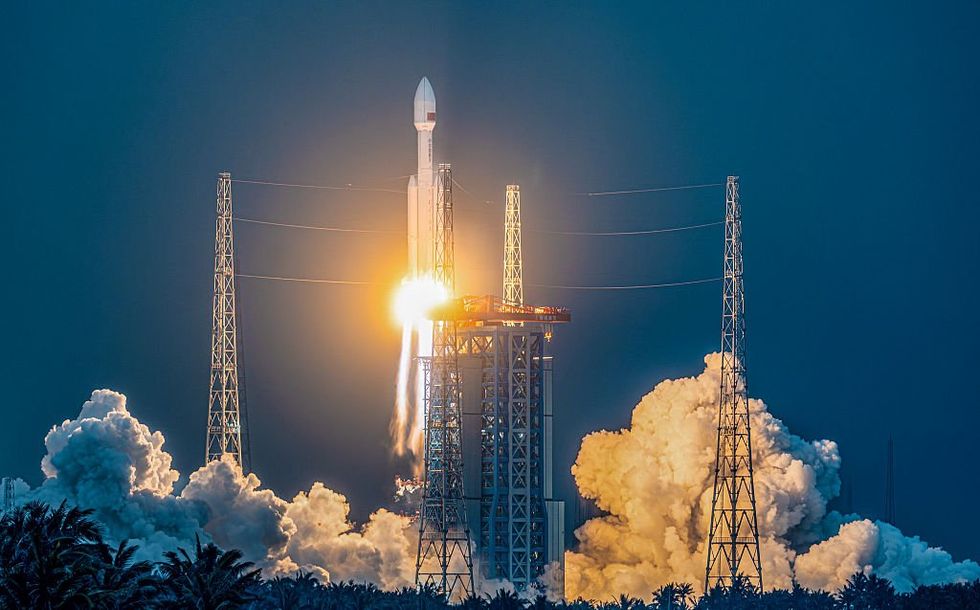
A Chinese rocket crashed into the South Pacific Ocean on Friday
|GETTY
The Zhuque-3, developed by the Chinese company Landspace, was designed to be partially reusable, similar to Elon Musk’s SpaceX Falcon 9.
On December 3, the rocket launched from Jiuquan Satellite Launch Centre in Gansu Province.
Despite the rocket’s reusable booster stage exploding during launch, the upper stages entered orbit.
The Zhuque-3 crashed twice, with US Space Force data indicating the rocket had broken up and created two fireballs, the first in the South Pacific Ocean and the second in the Indian Ocean.
LATEST DEVELOPMENTS

The UK's Prime Minister Sir Keir Starmer and China's President Xi Jinping
| PAThe majority of space debris burns up along its descent or cannot be located.
However, "space junk" is becoming an increasing concern as more material is being propelled into the Earth’s atmosphere.
This has been exacerbated by an increase in commercial launches, which in turn makes uncontrolled re-entries more likely.
Dr Mike Peel, Research Associate in the Department of Physics, Imperial College London, said: “There’s an ever-increasing amount of rockets and satellites being launched into orbit these days, both by commercial companies and governments, which will increase the risk of similar situations arising in the future.”
A study from the University of British Columbia in 2022 found there is now a 10 per cent chance there will be one or more casualties caused by fallen space junk in the next decade.
This is not the first time debris from an uncontrolled Chinese rocket hit the Indian and Pacific Oceans, causing panic across nations on its way down.
In July 2022, Nasa hit out at Beijing over concerns the 23-tonne Long March 5B booster could crash into a populated area.
That same weekend, a piece of space junk from a SpaceX capsule crashed on an Australian farm.
In 2024, another rocket crashed into a village in China’s Guangxi Province, narrowly missing a school.
Dr Peel said: "While most re-entering debris burns up in the atmosphere, there have been recent events of debris reaching the ground.
"Tracking and managing the space environment is becoming increasingly important, as is understanding the effects that satellite de-orbiting will have on the atmosphere.”
Our Standards: The GB News Editorial Charter
More From GB News