










“They cannot afford the £18 daily return fare to Manchester or Sheffield.”
Those two realities now define the experience of a generation of young Britons who are desperate to work, but who are increasingly locked out of opportunity by the rising cost of access to it.
Paul Bohan, chief executive of Buxton-based charity Zink, told GB News that for many young people in isolated towns, even reaching better-paid jobs is financially out of reach.
“They therefore work locally in minimum wage jobs which are often part-time or seasonal due to the Peak District economy’s reliance on tourism,” he said.
TRENDING
Stories
Videos
Your Say
“Low-paid, temporary work leads to young people getting stuck in a cycle where they struggle to move up the career ladder.”
Alice Hendy, founder of charity Ripple, told GB News the consequences are not just economic, but deeply personal.
“For young people, student debt, unaffordable rents and the gap between wages and living costs are creating a generation that feels locked out of stability before they’ve even started,” she said.
Against that backdrop, fresh Office for National Statistics (ONS) data reveals the scale of the challenge.

A generation locked out of work before they’ve begun
|GETTY
Some 16.1 per cent of those aged 16 to 24 are unemployed, more than three times the national rate of 5.1 per cent. The figure excludes those not actively seeking work due to illness or ongoing studies, suggesting the true scale of disengagement may be higher.
Close to one million young people are not in education, employment or training, according to recent Government-backed analysis, with the sharpest increases concentrated in former industrial regions.
Sectors that traditionally provided first opportunities, including retail and hospitality, are cutting staff or freezing recruitment as businesses grapple with rising costs. Graduate roles have also become harder to access, leaving even university-educated candidates struggling to secure entry-level professional positions.
Lucy Gabb, a Cambridge University graduate from July 2025, told the BBC she is working in a London café while applying for publishing roles, having submitted more than 50 applications with just one interview.
LATEST DEVELOPMENTS:

Financial stress is contributing to a growing mental health crisis
|GETTY
“Entry-level jobs are just so competitive and they’re asking for experience that is impossible to get whilst you’re also studying,” she said.
Alex Huke, 21, from County Durham, told the BBC he spent four months unemployed before securing a care role after applying for 40 jobs.
“It’s quite discouraging as you don’t hear back from a lot,” he said, adding that Jobcentre support “felt as though it was there more to monitor me than help me find a job”.
Even when work is secured, the cost of getting there is becoming a growing barrier.
British workers now spend an average of £2,500 a year commuting, according to Bionic research, with some paying significantly more. Ms Poulton, senior financial coach at Octopus Money, said rising housing costs are pushing workers further from economic centres.
“We’ve seen people spending £40 or £50 a day just to get to and from work,” she said.
Transport costs have risen faster than inflation in recent years, with Tube and rail fares increasing by 4.6 per cent in March 2025. For younger workers on lower salaries, these costs can absorb a substantial share of income.
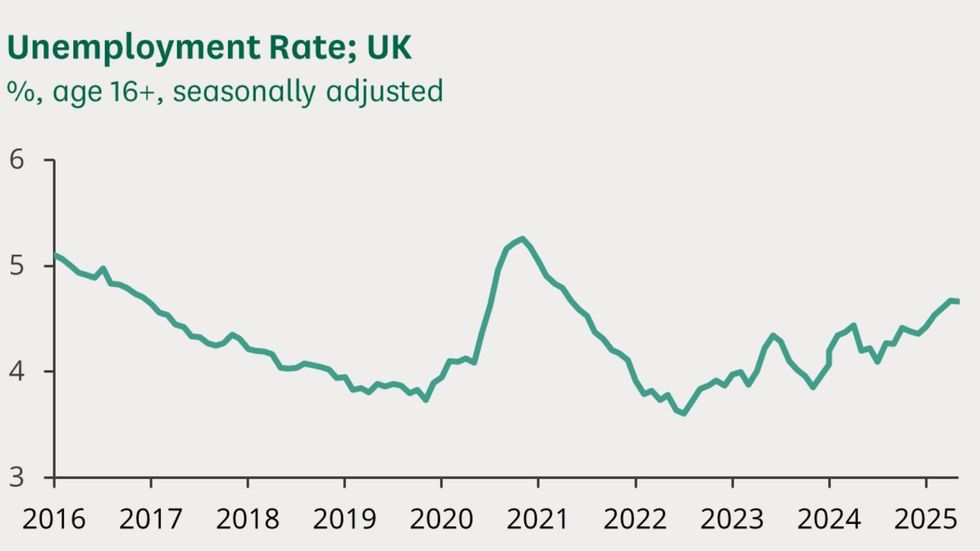 Unemployment in the UK has hit 5.2 per cent | Commons
Junior writer Kia-Elise Green previously paid £600 a month commuting from Buckinghamshire at age 19, underlining how travel costs can erode the financial benefit of employment altogether.
For many, geography itself has become a barrier.
Analysis by the Institute for Public Policy Research suggests the north of England has received around £140billion less in transport investment than if spending had matched London levels over the past decade.
Matthew Allen, lecturer in economics at the University of Salford, told GB News that geography remains a key determinant of economic outcomes.
“Evidence from the Social Mobility Commission consistently shows that where someone grows up still heavily influences where they end up economically,” he said.
He added that inequality is increasingly “hyper-local”, with stark contrasts even within cities.
In Manchester, areas such as Harpurhey and Moss Side rank among the most deprived nationally, while nearby Didsbury and Altrincham have significantly higher incomes and stronger labour market connections.
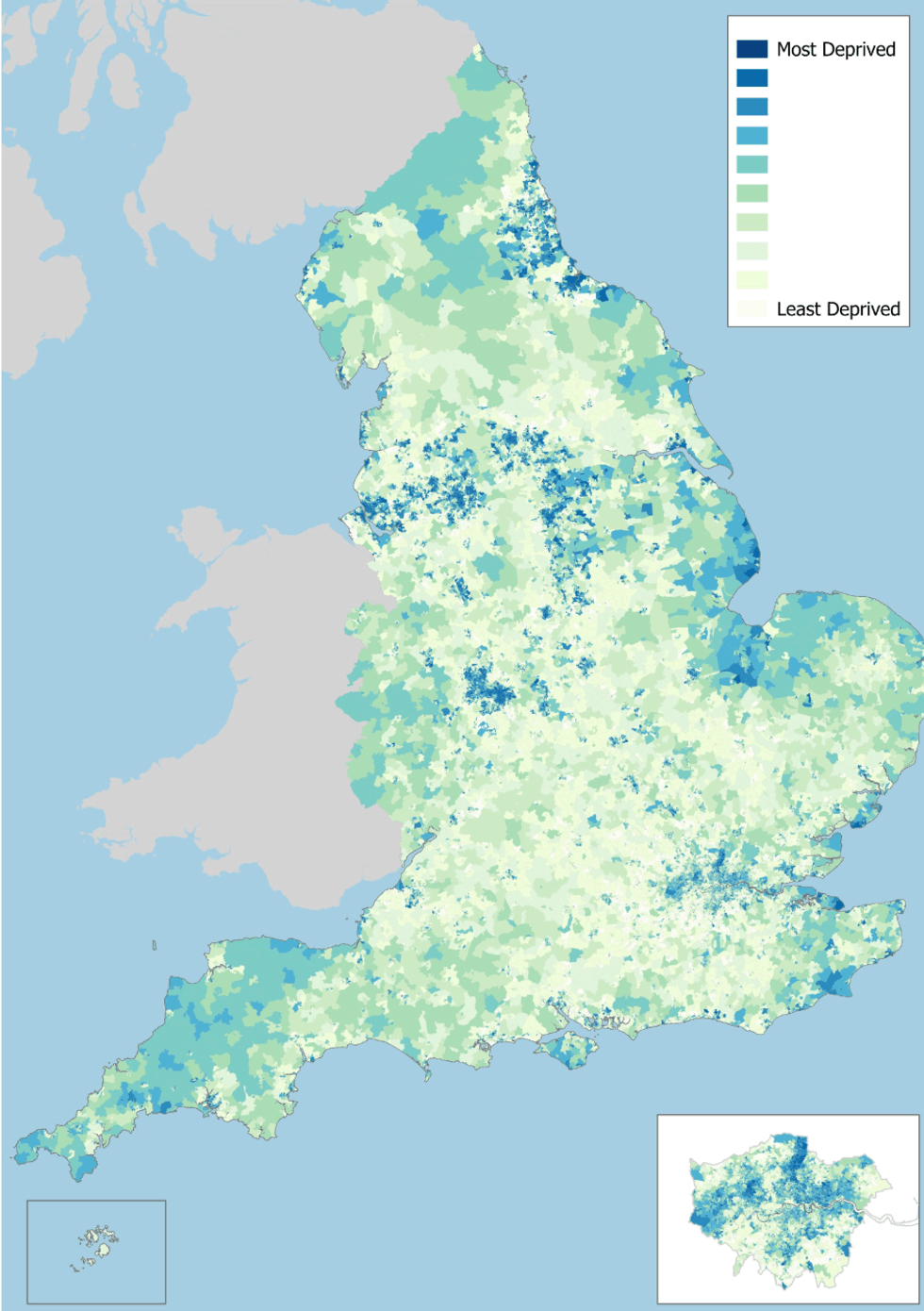
Distribution of the Index of Multiple Deprivation 2025
|ONS
High-skilled industries remain concentrated in London and the South East, creating what Mr Allen described as a “pull effect” that reinforces prosperity in already successful areas.
“For many young people, access to opportunity is not just about where jobs exist, but who can afford to reach them,” he said.
Housing pressures further compound these challenges. Home ownership among 25 to 34-year-olds has fallen from around half in previous generations to below 30 per cent today, while first-time buyers now face property prices close to six times average earnings nationally.
In areas such as Buxton, Mr Bohan said there is a shortage of one-bedroom homes, with rents outpacing what entry-level wages can support.
Policy can also create unintended barriers. Supported Housing Allowance, which provides £100 to £150 per week in additional support, is often withdrawn immediately when tenants enter work.
“That can see rent jump from £120 to £240 a week overnight,” Mr Bohan said. “It actively discourages people from working.”
The pressures are increasingly taking a toll beyond finances.

Accessing work becomes ever more expensive
|GETTY
Ms Hendy told GB News financial stress is contributing to a growing mental health crisis.
“Research from Mind found that around 2.7 million people considered taking their own life during the cost-of-living crisis due to financial pressure,” she said.
Ripple’s browser extension, downloaded more than two million times, has intercepted over 110,000 harmful online searches, many linked to debt and financial distress.
Chronic financial stress can damage sleep, relationships and physical health, while reducing the ability to seek help. Ms Hendy added that the issue is deeply personal, with her brother applying for 72 payday loans in the six days before his death.
The longer-term economic implications are significant. The Social Mobility Commission estimates that improving social mobility to average Western European levels could add around £39billion annually to UK GDP.
Yet there are growing warnings the UK lacks a coherent strategy to address these issues, with critics arguing that policy responses remain fragmented.
At the same time, some young workers are choosing to leave.
Around 90,000 Britons emigrated in the year to mid-2022, while sectors such as healthcare are already seeing an outflow of talent, with nearly 10,000 doctors leaving the UK workforce last year.

Youth unemployment is reaching crisis levels
|GETTY
Real incomes are forecast to fall by around seven per cent over a two-year period, according to the Office for Budget Responsibility (OBR), while the overall tax burden is at its highest level since the Second World War.
For some, the calculation is increasingly straightforward.
Higher wages, lower taxes and improved quality of life abroad are prompting what some analysts describe as a growing brain drain.
Despite this, the Government has pledged to tackle youth unemployment through its Youth Guarantee Scheme, aimed at expanding apprenticeships and work opportunities for 18 to 21-year-olds.
But questions remain over whether current policies match the scale of the challenge.
Olivia Diss, a 24-year-old graduate from Essex living with her parents while claiming Universal Credit, said: “How are they going to ensure our degrees are put to use?”
Mr Allen said meaningful progress would require a long-term approach, including better links between education and employment, targeted support for commuting and relocation, and sustained regional investment.
“Ultimately, the challenge is not just creating opportunity,” he said, “but ensuring young people across all regions can access it”.
Without that shift, the risk is that the cost of getting to work, and where someone grows up, continues to define what they can become.