










Youth joblessness has climbed to a record post-pandemic high as growing numbers of young Britons stop looking for work altogether, new official figures show.
An estimated 1.012 million people aged 16 to 24 were not in education, employment or training (NEET) between January and March 2026, according to the Office for National Statistics.
That was up by 89,000 compared with a year earlier and 55,000 higher than the previous three-month period.
The proportion of young people classed as NEET rose to 13.5 per cent, up from 12.5 per cent a year earlier.
The increase was driven largely by more young people becoming economically inactive, meaning they were no longer actively searching for work.
Elise Rohan, head of labour market output at the ONS, said the figure marked the highest level in more than 12 years.
A separate government-backed review led by former health secretary Alan Milburn warned Britain risks creating a "lost generation" as more young people become permanently detached from the labour market.
The interim report found that six in 10 young people classified as NEETs have never had a job, compared with four in 10 twenty years ago.
Mr Milburn said: "Detachment is no longer temporary. For too many young people it is becoming permanent. We are at risk of a lost generation."
In response to the growing crisis, Work and Pensions Secretary Pat McFadden is expected to announce plans for 300,000 extra work experience placements over the next three years.
The Department for Work and Pensions stated the government wants to "give every young person the best start in their career".
Mr McFadden said: "I commissioned this report because we cannot afford to lose a generation of young people, and I welcome Alan Milburn's vital work which lays bare the scale of the challenge and the root causes of youth unemployment we now need to confront."
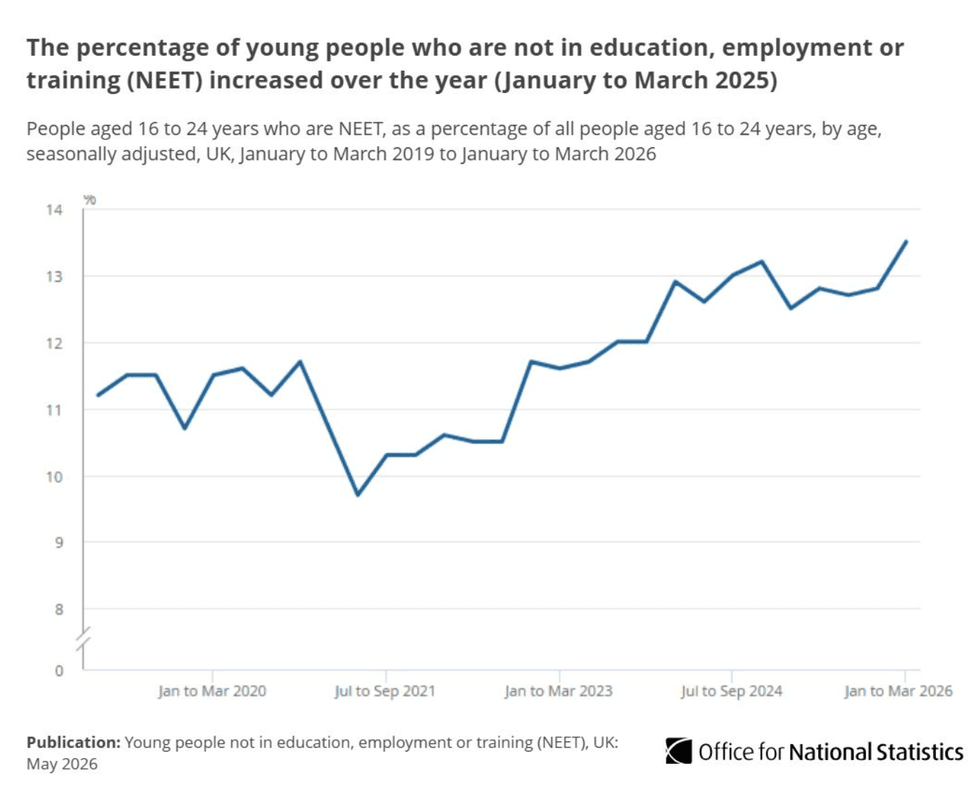
The was driven by greater numbers of young people no longer looking for work
|ONS
Jon Fitzmaurice, Head of External Engagement at the Work Foundation at Lancaster University said: "The Milburn Review is right to describe this as a systemic failure."
He added that around eight in 10 young people classed as NEET still want a job, despite facing "an increasingly difficult route into stable employment" as vacancies continue to fall and entry-level opportunities weaken.
Mr Fitzmaurice also warned that current Government support schemes appeared too limited given the scale of the problem.
He continued: "The Jobs Guarantee and Youth Jobs Grant could help some young people into work, but together they are expected to support around 50,000 people a year.
"In an unforgiving labour market, much more ambitious action will be needed."

Long periods outside work or education can damage career prospects
| GETTYEmeritus Professor Joe Nellis, economic adviser at accountancy and advisory firm MHA, said Alan Milburn's review highlighted how difficult it has become for young people to secure their first foothold in the jobs market.
He warned the issue was no longer just a short-term employment problem, but a sign of deeper structural challenges affecting economic opportunity, social mobility and the long-term health of the UK economy.
Referring to the Milburn review, he said young people were facing fewer opportunities and tougher competition for entry-level roles, while higher living costs and financial pressures were making it even harder to enter the workforce.
"The longer you are out of work, the more unemployable you become," Professor Nellis said, warning that long periods outside work or education can damage career prospects, reduce lifetime earnings and increase the likelihood of insecure employment.
He also said the impact extended beyond individuals and posed wider risks to the economy through lower productivity, weaker tax revenues and increased pressure on welfare and public services.
Professor Nellis warned that many young people now feel locked out of opportunities such as stable jobs, financial security and home ownership that previous generations had expected.
"If these trends continue, inequality will rise, social mobility will decline, and frustration over economic fairness across the UK is likely to intensify," he said.
He added that without stronger employment pathways, better skills training and greater business investment in younger workers, the economic and social consequences could persist for years.
Mr McFadden has previously described youth unemployment as "a quiet crisis, a ticking timebomb, which risks their future working lives", warning its effects could leave lasting damage throughout people's careers.
He committed to "work across government and with employers, charities and young people to drive real change, so more young people are earning or learning, not left behind".
Mr Milburn's review concludes the problem lies not with young people themselves but with outdated institutions failing to adapt.
He said: "This is not a failure of young people. It is a failure of a system stuck in the past."