







Asian stock markets suffered their steepest falls in years on Wednesday, as the deepening Middle East crisis triggered emergency trading halts and sent shockwaves through global financial markets.
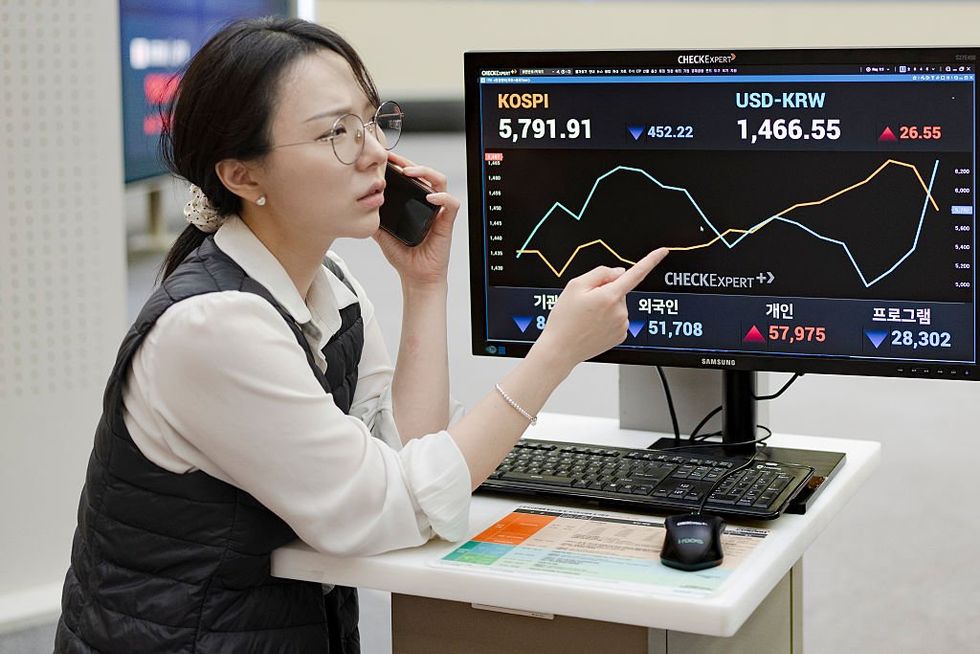
South Korea’s benchmark Kospi dropped 12 per cent, forcing the Korea Exchange to activate an emergency circuit breaker that froze trading for 20 minutes in an attempt to prevent panic selling.
Thailand’s main index also halted trading after falling more than eight per cent, while Japan’s Nikkei 225 slid 3.6 per cent in another heavy session for the region.
Hong Kong’s Hang Seng Index was down 2.5 per cent in afternoon trading and the Shanghai Composite slipped 0.8 per cent.
TRENDING
Stories
Videos
Your Say
The rout marked the third consecutive day of sustained selling across Asia as investors reacted to the prospect the US-Israel conflict with Iran could become prolonged, disrupting global energy supplies and fuelling renewed inflationary pressures.
Brent crude rose a further 2.5 per cent to 83.96 US dollars a barrel, leaving it 15 per cent higher than on Saturday when Israel and the United States began strikes on Iran, while Tehran retaliated with attacks on neighbouring Arab states.
Gas prices also surged as vessels operating near the Strait of Hormuz came under attack, raising concerns over supply disruption through one of the world’s most strategically significant shipping lanes.
The UK Maritime Trade Operations Centre said a ship near the United Arab Emirates was struck by an "unknown projectile" on Wednesday, although no fire was reported and the crew were unharmed.
The exchange crashed overnight
|GETTY
Roughly one-fifth of global oil and gas supplies typically transit the narrow waterway, but traffic has slowed sharply after Iran threatened to "set fire" to ships passing through the area.
Donald Trump said the US Navy would escort commercial vessels "if necessary" and provide risk insurance "at a very reasonable price" to safeguard the "free flow of energy".
Analysts cautioned such assurances may prove insufficient to calm markets already unsettled by the risk of an extended conflict.
Lindsay James, investment strategist at Quilter, said: "Investors are increasingly pricing in a growing probability of this conflict just taking longer to resolve."
LATEST DEVELOPMENTS
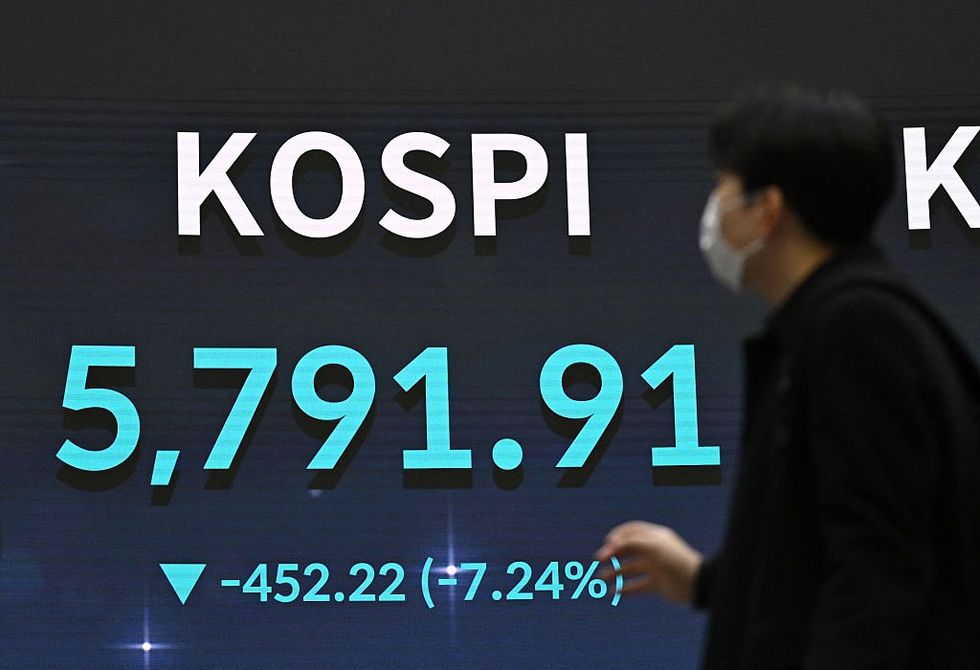
The Kospi was frozen for 20 minutes
|GETTY
Export-dependent economies such as South Korea and Japan were among the hardest hit, with the Kospi recording one of its sharpest daily falls in decades.
Trading in Seoul was automatically suspended for the first time since August 2024 as losses intensified.
Jack Lee, if the China Macro Group, said the slump reflected how "fragile" market sentiment had become, although he noted China had been relatively insulated due to diversified energy supplies, including imports of Russian oil.
The turmoil extended beyond Asia into the United States and Europe.
Overnight, the Nasdaq Composite fell one per cent, the Dow Jones Industrial Average declined 0.8 per cent and the S&P 500 lost nearly one per cent.
European markets also weakened, while early trading in London showed the Ftse 100 struggling for direction after a volatile open.
The index hovered around flat on Wednesday morning and remained about three per cent lower for the week following a broader sell-off.
Among individual companies, Pearson led the Ftse 100 risers while Intertek recovered some of the previous session’s losses.
Weir Group fell more than 6 per cent despite reporting stronger mining-related profits, while housebuilder Barratt Redrow declined after announcing a chief executive succession plan.
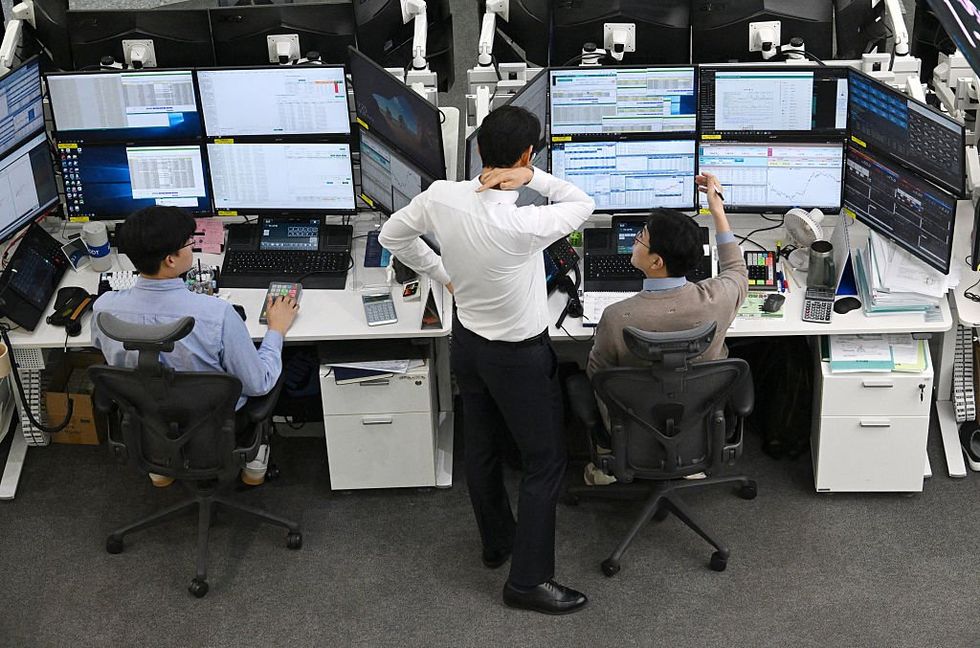
Shocks are being felt across the globe
|GETTY
On the Ftse 250, Vistry dropped 20 per cent following a trading update.
The market volatility came a day after Chancellor Rachel Reeves delivered her Spring Statement, during which the Office for Budget Responsibility (OBR) warned the Iran conflict could have a "very significant" impact on global economies.
Investors are factoring in the possibility of higher inflation, raising questions over whether the Bank of England will proceed with interest rate cuts that had previously been anticipated this year.
The Bank is scheduled to announce its next interest rate decision on March 19.
Our Standards: The GB News Editorial Charter
More From GB News