









Brexiteers will feel vindicated today as an analysis of the annual report from the European Commission’s official statistics agency exposes just how unequal the distribution of economic gains is across the bloc.
The report, from think tank Facts4EU in collaboration with Stand for our Sovereignty and CIBUK.Org, shows that, once again, the average wage varies dramatically across the 27 countries that make up the Union.
The findings destroy the main argument for joining the EU since its creation back in 1951.
Formed in the wake of a continent shattered by war, what was then known as the European Coal and Steel Community promised economic prosperity through integrating markets.
However, as previous reports from Facts4EU show, this dream has never been realised. Instead, countries have become increasingly tied up in regulatory knots and bound by legal obligations as political power has flowed to Brussels.
The latest Labour statistics provide further evidence that this dysfunction has produced clear winners and losers.
As the graphs below show, the differences between the lowest and the highest countries remain stark both in terms of average wages per hour and average non-wage labour costs per hour.
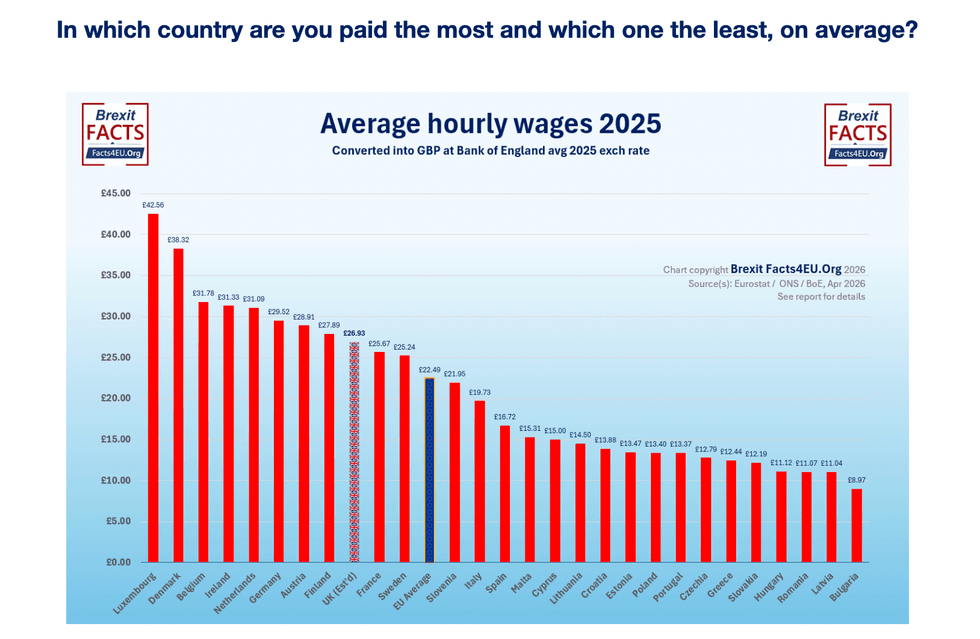
The differences between the lowest and the highest countries in terms of average wages per hour
|Facts4EU

The worst country for employers paying non-wage costs is France
|FACTS4EU
For the highest average wage, head for Luxembourg where the hourly rate is £42.56 (€49.69 euros). Over 50 per cent of its workforce do just that daily, commuting from one of the surrounding EU countries.
Conversely, if you are looking to get rich, it might be best to strike Bulgaria from your list. There, the average wage is getting on for only 1/5th of that in Luxembourg, at £8.97 per hour (€10.47 euros).
The extra costs employers have to pay on top of wage costs are, of course, another major factor when deciding to employ more people.
As the second graph shows, the worst country for employers paying non-wage costs is France, which is well-known for its state taking large contributions to try to fund its generous provisions for things such as healthcare.
For years, Facts4EU have been warning that the French economy is heading for a real bruising, and this is now happening, with its deficit and debt both at high levels and increasing.
At 4.8 per cent (compared to France's 32.3 per cent), Romania fares the best for employers paying non-wage costs. This makes Romania a low-cost, competitive environment for employment in Europe.
As Eurostat measure these costs as a percentage of the total labour costs, this is shown above.
In all these charts, Facts4EU have excluded countries where their figure is either unavailable or are under investigation for errors. In this case, this excludes Belgium and Malta.
The final graph below shows the change in total labour costs per hour from 2025-26.

All of the EU’s major economies, except Poland, find themselves in the bottom half of the table for growth in total labour costs per hour
|FACTS4EU
All of the EU’s major economies, except Poland, find themselves in the bottom half of the table for growth in total labour costs per hour. The clear outlier at the very bottom is France, with just two per cent.
As the People's Channel showed above, France has the distinction of having the highest non-wage costs, which have ramifications for employment and, therefore, wage growth.
Reset or regression?
The authors of the Facts4EU report point out that the latest Labour statistics counter the assertion that the EU provides a level playing field for all its members.
It also undermines the main justification for Keir Starmer's EU reset, which puts greater alignment with the bloc at the heart of Britain's renewal.