




Someone once said that meeting Peter Mandelson was a bit like walking downstairs, but missing the last step. You were physically uninjured, but somehow strangely discombobulated by the experience.
I can testify to the truth of this simile, having only met the disgraced peer once, but seeing enough of him through that short interaction to know that he was one heck of a slime-ball.
It was October 2004, in Strasbourg, where Mandelson was working for Tony Blair as the UK’s trade commissioner. A plum job for an arch-Federalist like Mandelson. But a surprise to many, given that by 2004 he’d resigned not once, but twice, from Blair’s Cabinet.
Our ‘meeting’ lasted all of ten seconds. I was with a Sky News camera crew, and Mandelson had been booked to do a live interview using our camera.
He walked towards me, offered a clammy handshake, but no word of introduction. Not a “hello”, “good afternoon” or “hi”. No, his opening gambit was: “I had dinner with Jamie last night.”
I must’ve looked nonplussed. Jamie who? Mandelson replied with two words: “James Murdoch” [the then CEO of Sky TV]. This was classic Mandelson.
Presumably, he assumed that by mentioning the name of my ultimate boss, and saying nothing else by way of welcome, I would be cowed into some sort of pliability.
That was what I took away from that brief encounter. Imagine what it must’ve been like being around such a sheister more often. And yet people did want to share his oleaginous company. And, as we now know, they included Jeffrey Epstein.
But the real question is this: what did the people who gave Mandelson his chance in British public life see in him? What kind of person would promote and re-promote someone so obviously and odiously repellent?
The person who really needs to answer this question is Tony Blair. According to some accounts of New Labour’s rise to power, the former Prime Minister was every bit as much Peter Mandelson’s creation as Keir Starmer was Morgan McSweeney’s.
But even as Mandelson arranged Blair’s ascent, he was already the object of suspicion. People who worked on the Blair campaign had no idea how much Mandelson was involved. Blair referred to him by a nom de plume: ‘Bobby’. Even then, in the 1990s, he was divisive, and his tracks had to be covered.
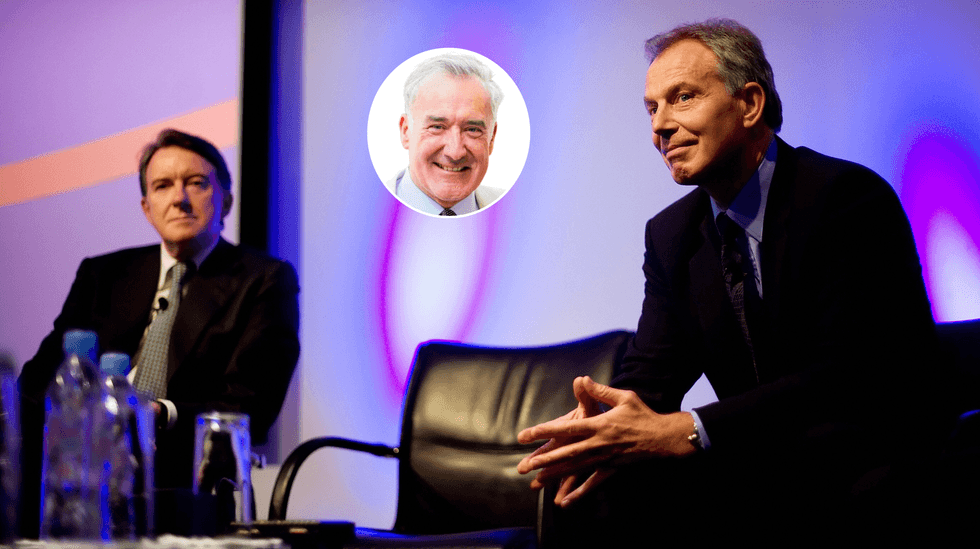
There is a Tony Blair-sized hole in the Peter Mandelson scandal that urgently needs attention - Colin Brazier
|Getty Images
So why is it then that Blair now has nothing to tell us about ‘Bobby’? How can it be that a politician who turned apologising into an art form has yet to say sorry about Mandelson?
The contrast with the royal family is striking. This week, King Charles released a statement about Andrew Mountbatten-Windsor, in which he talked about his “profound concern”. Prince William said he was “deeply concerned” about Andrew’s role in the Epstein affair.
Charles could not choose his brother, any more than William can choose his uncle. They are both openly talking about regret. But Blair, who wasn’t lumbered with a relationship with Mandelson by some accident of birth - but who repeatedly chose to consort with him, has nothing to say by way of contrition.
The truth is that the British people are owed an apology from Blair. Not just for his championing of a wrong ‘un like Mandelson. But for the other decisions he made in those ten years after 1997. A decade which, subsequently, has been proven to be behind so many of our nation’s difficulties.
As I tweeted recently: “Mandelson’s undoing may end Starmer, but it also confirms the utter rottenness of Blair’s legacy. So many of our current woes worsened sharply post-1997. Unfettered migration. Identify politics. University over-expansion. Devolved parliaments. Catastrophic.”
And this week, evidence of the extent of Blair’s toxic legacy was everywhere. Take Blair’s obsession with devolution. What was meant to act as a brake on secession from the UK ended up being an accelerator. More than any person alive today, Blair is responsible for what feels like the unstoppable breakup of Britain.
Anyone doubting how close we are to that sad reality only needs to look at Labour’s leader in Scotland, Anas Sarwar, attempting to knife his party leader, Keir Starmer, this week.
Sarwar became the most senior Labour figure to call for the Prime Minister to resign. It didn’t work. But it did reveal how politics in Holyrood and Westminster now march to totally different beats. Sarwar said he wanted a new prime minister, not because that was best for Britain, but because it was best for Scotland. So much for the Union.
And then there are our universities. In 1999, two years after coming to power, Blair announced that he wanted to see half of all young people go into higher education. This was a huge increase. When I went to university, about 10 per cent of school leavers did so. How would it be paid for? By tuition fees, of course. And what a disaster they have turned out to be.
More than 2.6 million younger Britons now have student debts in excess of £50,000 (they were promised big graduate pay cheques, but many wind up in McJobs).
Anyone who took out one of Blair’s loans must now start making repayments when their pay reaches £28,400. The interest rates are ruinous, and the cost of monthly repayments is holding back young people from milestones my generation took for granted. Rather important things for a stable society, like having a home and starting a family.
And then there’s the groupthink. Reform this week was barred from a debate at the students’ union of Bangor University, an institution in receipt of £30m of taxpayers’ money. Think about that: our most popular national party is prohibited from appearing on campus.
Our higher education sector has a very narrow definition of what Britons ought to think, and has sought to shape young minds accordingly.
The expansion of universities has been a disaster for individual students, many of whom would’ve been better off joining the workforce at 18. But it has also been a catastrophe for a generation who have been inculcated with values that began life, not here, but in American universities. Critical race theory, environmental guilt, and transgenderism.
And it was Blair who opened the door to those invasive ideologies. Just as it was Blair who also ushered in an era of identity politics.
The Equality Act of 2010 became law after Blair had left office, but his lawyerly fingerprints were all over legislation which gave force to the idea of ‘protected characteristics’.
One of the few characteristics not protected was to be white, and the natural, if insane, conclusion to this warped way of looking at the world is to have an official report like the one we saw earlier this month, which declared that the British countryside was “inherently racist” and “too white”.
The truth is that the Blair revolution, aided and abetted by Peter Mandelson, changed Britain forever and for the worse. Immigration after 1997 rocketed to a level never seen before. And those other changes - devolution, universities, and equalities - have acted as policy landmines that have only really detonated after Blair left office.
As Robert Jenrick wrote in the Telegraph this week: “Mandelson was the personification of a Blairite establishment that - 20 years after their leader left Downing Street - continues to govern much of Britain.”
From NGOs to the media. From Quangos to universities, the Blair project has long survived his premiership. Like a dose of depleted uranium, Tony Blair’s political gift to Britain has a half-life that will take decades to degrade. We deserve an apology.