








I live in Golders Green, I have for 35 years. I got an email from my daughter’s school today, just along the road from the latest antisemitic terror attack on jews, to tell me that they would not be leaving the school to play sport as planned, for safety.
I’m not Jewish. But today, like so many days recently, I felt something shift again—something darker, heavier, more frightening than it has any right to be.
Because this wasn’t just about one incident, it never is anymore.
Antisemitic attacks in the UK have been rising at an alarming rate. What used to feel like isolated, shocking incidents now feel like part of a pattern. one that is becoming harder to ignore and impossible to excuse.
Each new attack chips away at the idea that this is a tolerant country where Jewish people can live freely and safely. And for those who are Jewish, my friends, my neighbours, my daughters' school mates, this isn’t abstract. It’s personal. It’s daily. It’s exhausting.
I have friends who now think twice before wearing anything that might identify them as Jewish. Friends who check over their shoulders on the street.
Friends who have had to explain to their children why security guards are posted outside their schools, why plans change, why normal life is interrupted, and why they may have to leave the UK.
The kind of low-level fear that seeps into everything is hard to describe unless you see it up close—but once you do, you can’t unsee it.
And what makes it worse, truly infuriating, is how often this is met with silence, deflection, or selective outrage.
There are many people, particularly on the political left, who proudly and loudly identify as anti-racist. They march, they post, they campaign and in many cases, rightly so.
Racism in all its forms should be confronted. But too often, when it comes to antisemitism, that same clarity disappears. The energy fades. The outrage softens. Or worse, it is redirected, justified, or ignored altogether.
If you consider yourself anti-racist but turn away when Jewish people are targeted, if you rationalise it, minimise it, or treat it as somehow different, then something has gone badly wrong.
Because antisemitism is racism. It is not a lesser form. It is not an exception. And it cannot be tolerated under the banner of any cause, however strongly you feel about it.
You cannot claim to stand for all communities while quietly excluding one. If you do this, you are racist.
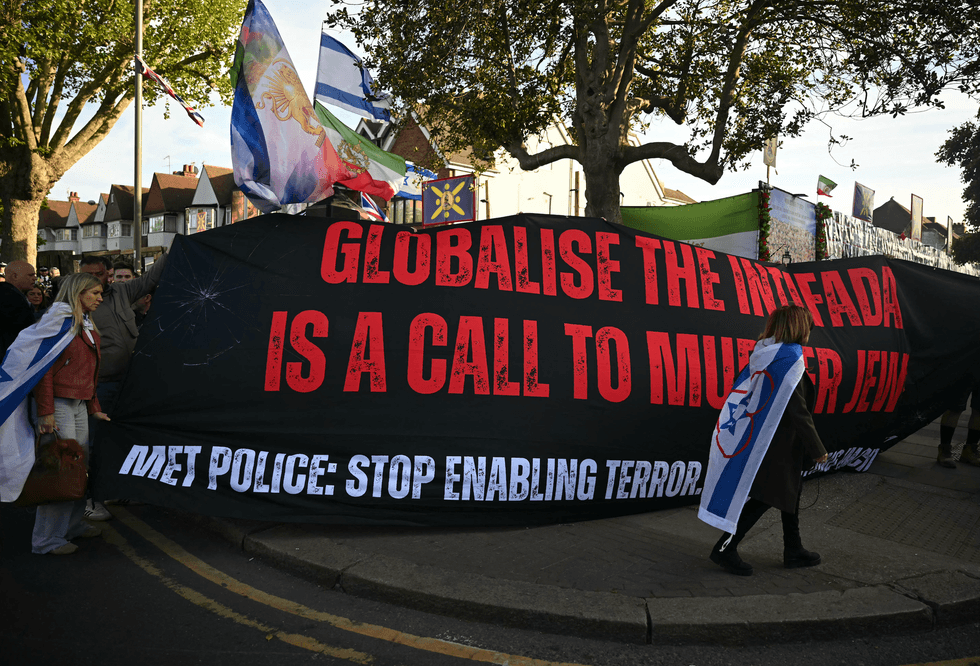
Over the past three years, London has seen near-weekly pro-Palestine marches. People have the right to protest, to express political views, to call for change.
That is part of a democratic society. But alongside those marches, there have been repeated shouts of antisemitic slogans, intimidation, and rhetoric that crosses a line, from political protest into something far uglier.
For many Jewish Londoners, these marches haven’t felt like distant political statements. They’ve felt close. Overwhelming and at times, threatening.
Entire areas have been effectively shut down, and with that has come a sense that the city is becoming less accessible, less welcoming, less safe.
And when concerns are raised, they are too often dismissed or downplayed, as though acknowledging antisemitism somehow undermines or supports other causes. It doesn’t. It simply acknowledges reality.
I've lived in Golders Green for 35 years. I'll tell you who is really to blame - Renee Hoenderkamp
|Getty Images
Yesterday, in Golders Green, there was anger, not just at what happened, but at what feels like a pattern of response.
Political leaders spoke.
They condemned. They promised protection, more funding, more measures. And yet, the attacks continue as they do lip service to a community that sees them for what they are, for why they can’t support this section of voters.
The reassurances feel hollow, not because the words are wrong, but because they are not matched by visible change.
People are tired of hearing that everything will be done while knowing that not enough actually is.
There is also a growing frustration about what is perceived as inconsistency in how extremism is addressed. Questions are being asked about how hate speech against Jews is monitored, how radicalisation is prevented, and whether the same standards are applied across the board.
What’s clear is this: words are not enough.
Communities don’t feel safe because of statements. They feel safe because of actions, consistent, visible, meaningful actions that reduce risk and rebuild trust. That applies to every group, and it must apply equally to Jewish communities as well.
I am not Jewish. But I live here. I see what is happening. I hear the conversations, the fear, the frustration. And I don’t think it’s acceptable to look away or to treat this as someone else’s problem
If any group in this country feels that they are being left out of the promise of safety and equality, that is a failure for all of us. And if antisemitism is allowed to continue to grow, whether through neglect, denial, or selective attention, then it will not remain contained. History has shown that clearly enough.
So this is not just about one attack in one place. It’s about what we are willing to tolerate, what we are willing to confront, and whether we are prepared to apply our principles consistently, even when it’s uncomfortable, even when it challenges our own side.
Because if anti-racism means anything, it has to mean this too.