









Unless you have been clearing snow in the last few days and missed the news, you will have heard about the 'Farage Clause'.
I assembled my ‘Star Chamber’ of top-flight lawyers to comment unofficially for GB News readers.
It has slipped out, doubtless deliberately, from Brussels, that the EU Commission intends to insert these clauses into agreements such as that of the SPS food deal, and all others arising from Sir Keir’s EU ‘reset’.
These unaccountable bureaucrats dictate that in the event of a Farage-like person being elected to No.10 who swiftly repudiates these deals, a punitive sum is to be paid by the UK to the EU for a lifetime supply of extra-large Kleenex.
Or something like that. More seriously, these punitive sums are reported to be on the large side. It has been pointed out, especially by No.10, that it’s perfectly normal for international deals like those between Starmer and his EU ‘friends’ to contain some form of cancellation clause, and this is true.
What is not normal is for the other party to be talking about these in such personal terms, even in private. Nor is it normal for them to contain such harsh penalties as have been mooted. This is reminiscent of the EU’s whole reaction to the British people voting to leave the bloc in 2016.
Readers will doubtless remember Jean-Claude Juncker’s famous line: “This will not be an amicable divorce.”
The former EU Commission President uttered this on the morning the result was announced on the 24th of June, before a word had been spoken between the two sides.
The fact that ‘Farage clauses’ were mentioned by the EU at all is, in itself, a little troubling. This is suggestive of a somewhat vexatious attitude from the EU. Now there’s a surprise.
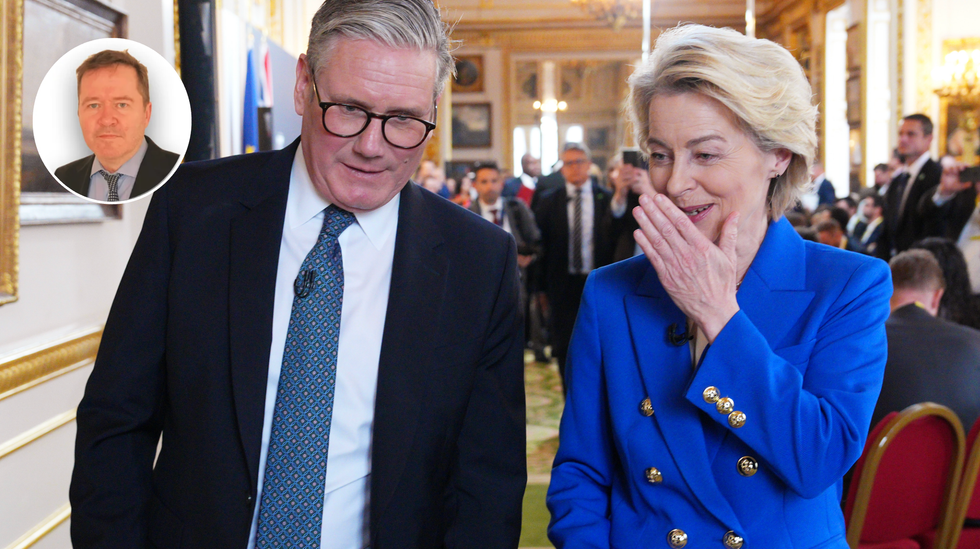
The 'Farage clause' is designed to distract you from the mother of all Brexit betrayals - Leigh Evans
|Getty Images
The danger with any legal argument about these Farage Clauses is that they will bypass the main point. It is surely that all these various arrangements – fishing, SPS food, free movement under the ‘Youth Experience Scheme’, etc – are all part of the process of dragging the UK back into the EU to all intents and purposes, when prior to the election, Starmer and colleagues promised to honour Brexit.
These clauses may be a “democratic outrage”, as Nigel says, but Sir Keir will be delighted if the argument revolves around these, rather than a broader argument.
Nigel would make Starmer dour again if we all went back to attacking these deals on the basis that they are a betrayal of Brexit. Farage and Badenoch need to make clear that, whatever the architecture of a new treaty with the EU, they reserve the right to use the Parliamentary Prerogative to repudiate it unilaterally and to repeal any incorporating legislation.
And that any such treaty will have no democratic legitimacy, as it was not in the Labour manifesto. We should stick to opposing Sir Keir taking us back in, quietly and step-by-step.
This seems to be the consensus of the ‘Star Chamber’ of top-flight lawyers, which I assembled to give readers the best possible advice. This demonstrates the critical weakness of EU law - it has no remit beyond the EU unless the subject party agrees.
As with the dreadful Windsor Framework, Brussels can demand all the guarantees it likes, but the next government cannot be bound by anything done by the current one.
The first thing would be to stop payments to the EU agreed by Starmer. What can they do? Take us to the European Court of Justice? We can refuse to recognise its jurisdiction. Impose tariffs?
We could impose higher tariffs on EU goods. We could revoke fishing licences. It should be made clear to the EU that a sovereign British Parliament can undo everything and anything agreed by Starmer, especially when it is an express breach of his election manifesto.
And they should also make clear that international agreements making commitments that cannot be broken in international law for any more than short periods (save peace treaties and similar) are profoundly undemocratic.
If the EU understands that, in Britain, Parliament is sovereign, that would be a start. It might even put them off imposing such penal clauses completely
More From GB News